
Research & Science
The Science Behind Tetride®
Over 15 years of breakthrough research at UCLA’s Kaner Laboratory has produced a novel class of superhard materials that could transform industrial manufacturing.
The Material
What is Tetride®?
Tetride® is SuperMetalix’s proprietary novel, superhard metal boride formulation — the culmination of materials research at UCLA. The material is capable of scratching diamond, which means in at least one crystallographic orientation it is as hard as diamond.
However, unlike diamond (and cubic boron nitride) it does not require high pressures to synthesize, thereby increasing cost-effective scalability. Facile synthesis on par with tungsten carbide, with mechanochemical properties approaching those of diamond and cubic boron nitride, allows for complex geometries at a fraction of the cost — making a new generation of superhard materials economically viable.
Research past to present
UCLA Kaner Laboratory
Dr. Richard Kaner’s research group at UCLA began exploring transition metal borides as superhard materials over two decades ago. Initial work centered on osmium diboride (OsB₂), demonstrating that dense metal-boron covalent networks could produce extreme hardness — a discovery published in the Journal of the American Chemical Society and Science that established the metal boride class as viable superhard candidates.
Research progressed to rhenium diboride (ReB₂), which achieved superhard-class hardness under ambient synthesis conditions — a breakthrough published in Science (2007) that opened the door to industrial-scale production without the ultra-high pressures required for diamond or cubic boron nitride synthesis.
Through four generations of formulation experiments, the Kaner Laboratory identified and optimized the composition that became Tetride®. Combining Tetride® with other metals and ceramics overcomes the brittleness that pure metal borides exhibit, while delivering the hardness and fracture toughness required for real-world cutting tool and abrasive applications — and doing so through synthesis routes compatible with standard industrial equipment.
Incompressibility and superhard materials — explained by the Kaner Laboratory.
Material Properties
Hardness Comparison
How Tetride® stacks up against the materials currently used in industrial cutting tools and abrasives.
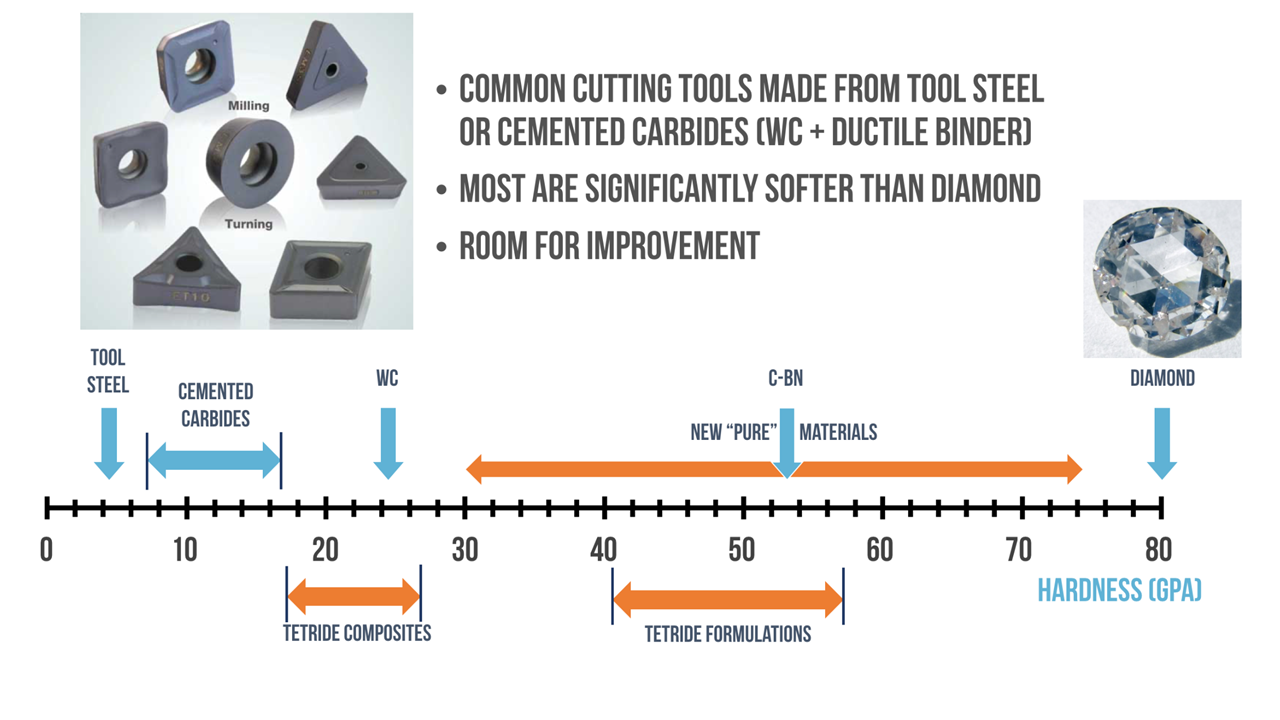
Tetride® Composites (17–30 GPa) and Tetride® Formulations (40–55 GPa) compared against tool steel, cemented carbides, tungsten carbide, c-BN, and diamond.
Research Programs
Active Research Areas
Superhard Borides
Investigation of transition metal borides as viable alternatives to diamond and cubic boron nitride, with a focus on atomic-level hardness mechanisms.
Synthesis Methods
Development of scalable, cost-effective synthetic routes for metal borides, whether superhard or ultrahigh temperature ceramics, enabling industrial-scale production.
Composite Formulations
Engineering Tetride® composite formulations that optimize hardness, toughness, and thermal stability for specific application requirements.
Radiation Shielding
Exploring metal boride structures for radiation attenuation applications in nuclear and medical applications.
Wear Resistance
Characterizing tribological properties and wear performance of Tetride® under industrial cutting and abrasion conditions.
Abrasive Grit
Developing large grain and particle sizes under ambient pressure to produce a lower-cost alternative superhard abrasive material.
Intellectual Property
Publications & Patents
25+ years of peer-reviewed research and a growing international patent portfolio for all Tetride® technologies.
Key Publications
The scientific foundation for Tetride® is documented in peer-reviewed journals including Science, PNAS, and the Journal of the American Chemical Society. The list below highlights a few key publications.
Designing Superhard Materials
Science, 2005 — Kaner et al.
Foundational framework for engineering hardness at the atomic level.
Osmium Diboride, An Ultra-Incompressible, Hard Material
J. Am. Chem. Soc., 2005 — Cumberland et al.
First demonstration of transition metal borides as superhard materials.
Synthesis of Ultra-Incompressible Superhard Rhenium Diboride at Ambient Pressure
Science, 2007 — Chung et al.
Landmark paper on ambient-pressure synthesis of superhard ReB₂.
Tungsten Tetraboride, an Inexpensive Superhard Material
PNAS, 2011 — Mohammadi et al.
Identified low-cost superhard boride compound with exceptional properties.
Rediscovering the Crystal Chemistry of Borides
Advanced Materials, 2017 — Akopov et al.
Comprehensive review of boride crystal structures for superhard applications.
30+ peer-reviewed publications from the UCLA Kaner Laboratory. Full list available upon request.
Patent Portfolio
SuperMetalix holds exclusive licensing rights to UCLA’s issued and pending patents covering Tetride® compositions, synthesis processes, and commercial applications. The portfolio includes multiple issued U.S. patents and international PCT filings, protecting both the core chemistry and key industrial use cases. Additional patents are actively pending as the technology continues to evolve.
Superhard Metal Boride Formulations
U.S. Patent — Core Tetride® composition claims
Synthesis & Processing Methods
U.S. Patent — Scalable industrial production routes
Cutting Tool & Abrasive Applications
U.S. Patent — Industrial use claims
International Patent Portfolio
PCT applications — key international markets
Full patent numbers and filing details available upon request.